
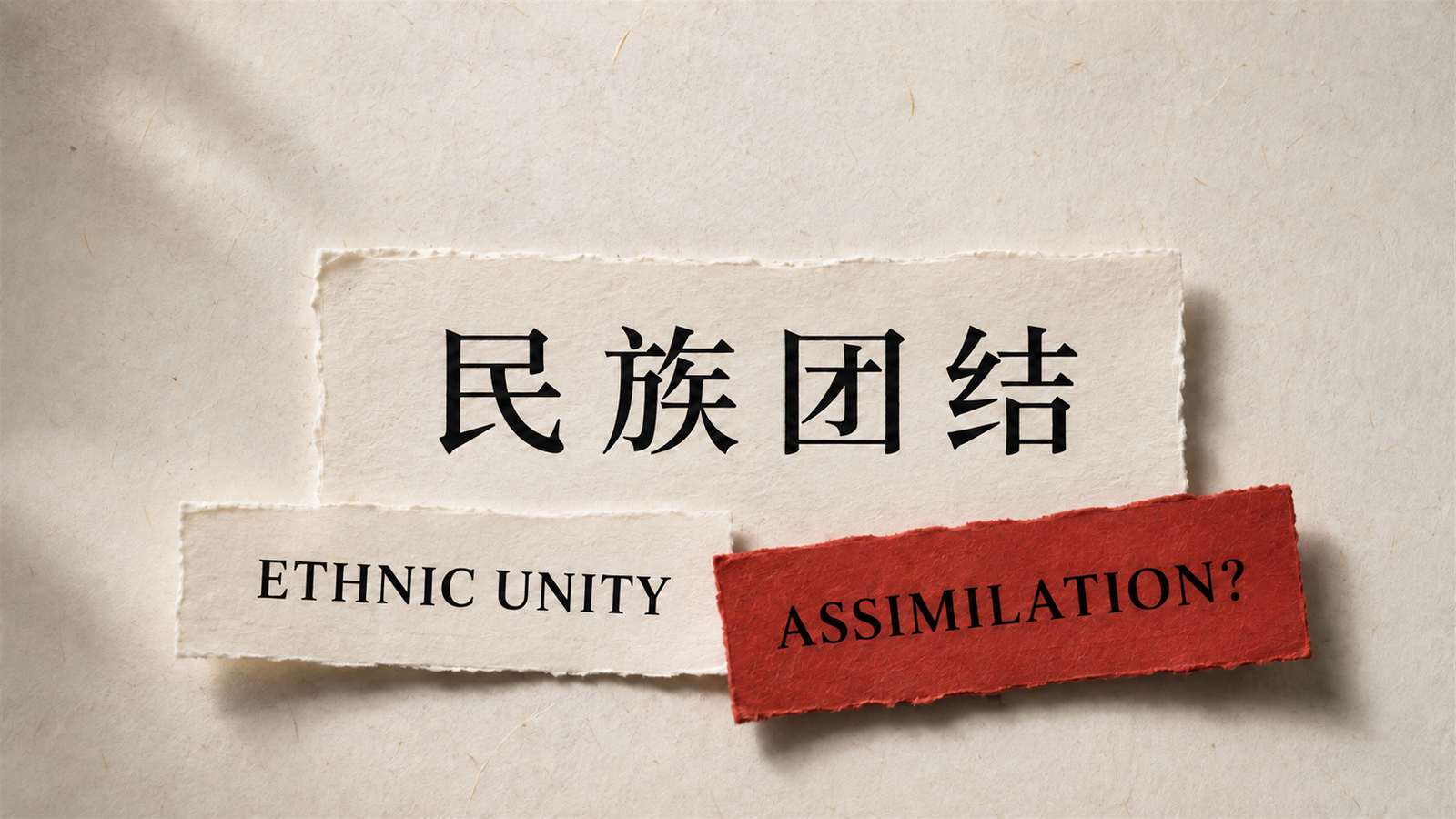
Four prominent English-language reports presented overlapping but not identical accounts of the People’s Republic of China’s new law on minzu unity. Between them, the law was described as requiring assimilation into Han culture, imposing “Mandarin Chinese” from “pre-kindergarten” through high school, and ending minority languages’ status as principal media of instruction. Some propositions appeared as reporters’ descriptions and others as attributed interpretations; each is identified separately below.[2][3][4][5]
The prior question is simpler: what does the enacted Chinese text actually say?
The National People’s Congress adopted the 《中华人民共和国民族团结进步促进法》 on 12 March 2026. The law contains 65 numbered provisions, called articles, and entered into force on 1 July.[1] It governs relations among the PRC’s officially recognised minzu and assigns duties concerning education, language, culture, religion, public administration, community life, media and the internet.
The PRC officially classifies its population into 56 民族 (minzu), meaning peoples or ethnic groups in this context. The Han, or 汉族 (Hanzu), are one of the 56 and form the demographic majority. The other 55 are officially classified as 少数民族, minority minzu.[7] The law does not place “the Chinese” on one side and Uyghurs, Tibetans, Mongols or other peoples on the other. In its own terminology, the Han and the other 55 are all among 各民族, “the various minzu”, and all are constituents of the encompassing 中华民族, the Zhonghua minzu.
The relationship is familiar in other national settings. In the United States, Navajo and Cherokee people, African Americans and Americans of European ancestry are all American. Switzerland’s German-, French-, Italian- and Romansh-speaking communities are all Swiss. In Finland, Finnish-speaking Finns, Swedish-speaking Finns, Roma and Sámi citizens are all Finnish. In the same sense, Uyghurs, Tibetans, Zhuang, Han, Mongols and Kazakhs are all Chinese.
The law’s stated purpose is greater cohesion, commonality and shared national belonging among those constituent minzu. It does not state that they are to become Han, cease to be distinct minzu, or abandon their languages and cultures. Those propositions entered the account in English.
National cohesion and ethnic assimilation describe different relationships. National cohesion strengthens common membership and institutions among distinct peoples. Ethnic assimilation erases those distinctions by making one ethnicity the destination for the others. The law requires national cohesion. It does not require the other minzu to become Han.
The Chinese passages below are quoted from the enacted text published by the National People’s Congress. The English renderings are by the author and follow that text and the statutory definitions cited below.[1]
The distinctions English must preserve
The English word “Chinese” can denote a state, citizenship, a national community, a civilisation, a culture, a writing system, a family of spoken varieties, a standard language, or Han ethnicity. Chinese does not express all of those meanings with one word.
The distinctions central to this law are:
| Chinese expression | Reading | Meaning in this legal context |
|---|---|---|
| 中国 | Zhongguo | The country of China, or the Chinese polity |
| 民族 | minzu | A people or ethnic group; its precise level depends on the expression in which it appears |
| 汉族 | Hanzu | The Han minzu, one of the 56 |
| 各民族 | ge minzu | The various peoples or ethnic groups, including the Han and the other 55 |
| 中华民族 | Zhonghua minzu | The Chinese nation, the encompassing national whole constituted by the various minzu |
| 国家通用语言文字 | guojia tongyong yuyan wenzi | The legally defined nationally common spoken and written language |
民族, minzu, most often identifies a people or ethnic group here. In 中华民族, however, it forms part of the term for the encompassing Chinese nation. No single English equivalent fits every construction.[8] 中华, Zhonghua, marks the national and civilisational whole presented in this statute as common to the various minzu. It is not the same expression as 中国, China as a country or polity, or 汉, Han.
China uses minzu as its principal legal category for the peoples within the state. A minzu is a historical people or ethnic community, not a biological race. Other states organise population classifications differently. United States federal standards use the social and administrative classification “race and/or ethnicity”. The census of England and Wales asks which “ethnic group” a person feels they belong to, with the answer potentially based on culture, family background, personal identity or physical appearance.[14][15] Neither system is a direct translation of minzu. In ordinary English, Article 5’s ban on discrimination and oppression against any minzu is an anti-racism and anti-ethnic-discrimination provision.
The important point does not require the reader to know Chinese characters. None of the terms for Han, the Han ethnic group, the Han language, assimilation into the Han, or assimilation appears anywhere in the law. When the law names the participants, it says “the various minzu”. When it names the shared national whole, it says “the Zhonghua minzu”. When it names the common language standard, it uses the separate legal expression “the nationally common spoken and written language”.
These expressions name three different things: the peoples who constitute China, the Chinese nation they constitute together, and the common language standard used by the state. English “Chinese” can refer to all three and can also be mistaken for “Han”. If those meanings are allowed to slide into one another, a law about cohesion among the Chinese peoples can be made to sound like a law requiring them to become Han.
Who is being united?
The conventional English title, Law on Promoting Ethnic Unity and Progress, identifies the statute but does not display the structure of its Chinese title:
中华人民共和国民族团结进步促进法
Law of the People’s Republic of China on Promoting Unity and Progress among the minzu
民族团结 means unity, solidarity or cohesion among minzu.[8] Chinese does not mark whether 民族 in the title is singular or plural, but the law repeatedly identifies the participants as 各民族, the various minzu. The title concerns their relations with one another. It does not describe their conversion into one ethnicity.
The preamble defines the national whole they form:
中华民族是各民族凝聚成的多元一体大家庭。
The Zhonghua minzu is one great family, formed by the various minzu coming together as a plural whole.
The two occurrences of 民族 have different referents. 各民族 names the constituent minzu. 中华民族 names the encompassing whole they constitute. 多元一体 holds plurality and unity together: 多元 identifies multiple components; 一体 identifies one whole. The whole is not called 汉族, and its constituents are not described as peoples outside it waiting to be made Chinese.
Article 6 states the governing relationship in full:
中华民族共同体意识是民族团结之本。国家坚持增进共同性、尊重和包容差异性,促进各民族守望相助、和谐共处,维护中华民族大团结。禁止破坏民族团结和制造民族分裂的行为。
Consciousness of the Zhonghua minzu community is the foundation of solidarity among the minzu. The state shall persist in increasing commonality, respecting differences and allowing room for them, promoting mutual support and harmonious coexistence among the various minzu, and safeguarding the great solidarity of the Zhonghua minzu. Conduct that undermines solidarity among the minzu or foments division along minzu lines is prohibited.
National unity is not assimilation or homogeneity. Commonality is to be increased, differences are to be respected and allowed room, and the various minzu are to support one another and coexist harmoniously. Article 6 places difference within the relationship through which unity is maintained.
The same structure appears elsewhere in the law. Article 5 declares all minzu equal and prohibits discrimination and oppression. Article 8 upholds and improves regional minzu autonomy. Article 13 calls the outstanding traditional cultures of all minzu constituent parts of Zhonghua culture. Article 29 encourages the various minzu to appreciate one another’s traditions and learn one another’s languages and writing.
The national centre named by the law is the Zhonghua minzu, not the Han. The various minzu constitute that encompassing community, and the law directs them toward greater cohesion within it.
What Article 15 says about language
Article 15 is the source of the most concrete errors in the English reporting. Its five paragraphs establish the place of the nationwide common language standard and the place of minority-minzu languages within the same legal arrangement.
The first paragraph states:
国家全面推广普及国家通用语言文字。任何组织和个人不得妨碍公民学习和使用国家通用语言文字。
The state shall comprehensively promote and popularise the nationally common spoken and written language. No organisation or individual may hinder citizens from learning or using it.
国家通用语言文字 does not mean simply “Mandarin”. Article 2 of the revised language law defines it as 普通话 and 规范汉字: Putonghua and standardised hanzi, the prescribed written characters.[9] It is a combined spoken-and-written legal standard.
Official terminology distinguishes the related expressions. 汉语 (Hanyu) is the broader linguistic category, including its standard form and regional varieties. 普通话 (Putonghua) is the prescribed spoken standard. 中文 (Zhongwen) is a broad term for the language as a medium and field. 规范汉字 denotes the standardised written characters. 国家通用语言文字 combines Putonghua and standardised hanzi as the nationally common legal standard.[10]
Putonghua is the standard form of modern Hanyu. Its pronunciation is based on Beijing phonology, its dialectal base on northern varieties, and its grammar on exemplary works in the modern vernacular.[10] This describes the linguistic basis of the standard. It does not turn the standard into an ethnic identity.
The second paragraph governs education:
学校及其他教育机构以国家通用语言文字为基本的教育教学用语用字。国家推动学前儿童学会普通话、完成义务教育的青少年能够基本掌握国家通用语言文字。
Schools and other educational institutions shall use the nationally common spoken and written language as the basic spoken and written medium of education and teaching. The state shall promote the acquisition of Putonghua by preschool children and basic mastery of the nationally common spoken and written language by young people completing compulsory education.
The provision applies to schools and other educational institutions. In its second sentence, the state is the grammatical subject: it is to promote preschool children learning Putonghua and young people completing compulsory education attaining basic mastery of the national standard. Nothing here singles out minority minzu.
基本 means basic. It gives the national standard a required institutional position. It does not mean sole or exclusive, and the paragraph does not say that another language may no longer be used for instruction.
学前儿童 means preschool children. Under the Preschool Education Law, preschool education includes education provided by kindergartens and other preschool institutions to children from age three until primary school.[11] It does not mean only children “before kindergarten”.
完成义务教育 means completion of compulsory education. The Compulsory Education Law defines compulsory education as a nine-year system.[11] It does not extend through senior high school.
The third paragraph concerns official documents:
国家机关以国家通用语言文字为公务用语用字。依照有关法律规定需要使用少数民族语言文字发布文书的,应当同时提供国家通用语言文字版本和少数民族语言文字版本。
State bodies shall use the nationally common spoken and written language in official work. Where, pursuant to relevant law, there is a need to issue a document using the spoken or written language of a minority minzu, versions shall be provided both in that language and in the nationally common spoken and written language.
The national standard is the language of official work. Where another law requires a document in a minority-minzu language, Article 15 requires both versions.
The fourth paragraph governs the use of both language systems in public:
国家机关、社会团体、企业事业组织和其他社会组织,在公共场合需要同时使用国家通用语言文字和少数民族语言文字的,应当在位置、顺序等方面突出国家通用语言文字。
Where state bodies, social groups, enterprises, public institutions and other social organisations need to use the nationally common spoken and written language together with a minority-minzu language in public, the nationally common spoken and written language shall be made prominent in placement, sequence and other respects.
The rule applies to the named organisations when both language systems need to be used together in public. It gives the national standard prominence in placement, sequence and other respects. It does not describe spoken “Mandarin” as something displayed, and it is not a general prohibition on displaying minority scripts.
The fifth paragraph states the position of minority-minzu languages:
国家尊重和保障少数民族语言文字的学习和使用,推动少数民族语言文字的规范化、标准化和信息化建设,支持少数民族古籍的保护、整理、研究和利用。
The state shall respect and safeguard the learning and use of the spoken and written languages of minority minzu, promote their normalisation, standardisation and development for digital use, and support the preservation, collation, study and use of ancient texts of minority minzu.
This is part of Article 15’s operative law. It does not merely acknowledge the existence of minority languages. It requires the state to respect and safeguard their learning and use, develop them for contemporary functions, and support the preservation and study of their written heritage. Reuters quoted the first sentence of this paragraph; the New York Times, BBC, Associated Press and The Guardian accounts examined here did not.[2][3][4][5][6]
The surrounding enacted laws follow the same structure. Article 12 of the Education Law requires bilingual education in autonomous-area schools and other educational institutions whose student bodies consist mainly of minority-minzu students. According to actual circumstances, they are to use the nationally common spoken and written language together with the relevant or locally common minority language.[12] Articles 36 and 37 of the Regional Ethnic Autonomy Law provide for autonomous educational planning and, where conditions permit, minority-language textbooks and teaching through minority languages.[13]
The legal arrangement is clear. The nationally common spoken and written language has a required and prominent role in education, administration and public joint use. Minority-minzu languages remain legally recognised and protected, with specified provisions for their use in bilingual education and, where relevant law requires, official documents. Article 15 assigns priority to a common national standard; it does not enact a “Mandarin-only” system or order speakers to exchange their minzu identity for a Han identity.
Interaction is not one-way absorption
The law repeatedly uses the expression 各民族交往交流交融:
interaction, exchange and intermingling among the various minzu
交往 describes interaction or association. 交流 describes exchange. 交融 describes intermingling or becoming more closely interwoven. The grammatical participants are the various minzu. No Han destination is named.
Article 29 makes the relationship explicitly reciprocal:
国家增进各民族文化互鉴融通,鼓励各民族互相欣赏优秀传统文化、互相学习语言文字。
The state shall promote mutual learning and interconnection among the cultures of the various minzu and encourage them to appreciate one another’s fine traditional cultures and learn one another’s languages and writing.
互鉴 means mutual learning. 互相 appears twice: the minzu are to appreciate one another’s cultures and learn one another’s languages and writing. The provision does not say that minority minzu must learn Han culture and Hanyu while the Han remain unchanged. It describes reciprocal relations among all the minzu.
Articles 22 to 30 pursue this cohesion through community planning, housing, population mobility, employment, education, tourism and cultural activity. These are state-directed measures for increasing contact and common social life. The statute calls the process interaction, exchange and intermingling. It does not call it Han assimilation.
Religion in the national framework of China
Article 46 assigns duties to religious institutions:
宗教团体、宗教院校和宗教活动场所,应当开展铸牢中华民族共同体意识宣传教育,坚持我国宗教中国化方向,引导宗教与社会主义社会相适应,引导宗教教职人员、信教群众弘扬爱国主义传统,促进民族和睦、宗教和顺、社会和谐。
Religious organisations, religious academies and places of religious activity shall conduct publicity and education to build firm awareness of the Zhonghua minzu as a shared community; adhere to the direction of Sinicising religion in our country; guide religion to adapt to socialist society; guide religious clergy and believers to carry forward traditions of patriotism; and promote amity among the minzu, harmony in religious relations and social harmony.
The expression 我国宗教中国化 is rendered here as “Sinicising religion in our country”. In this expression, 中国 means China as a country and state. The direction is to shape religion so that it accords with China’s values and state order. It does not mean making religion Han. That would be 汉化, a word Article 46 does not use.
Article 46 then separately requires religion to adapt to socialist society. It also requires religious institutions to strengthen awareness of the shared Zhonghua minzu community, carry forward patriotic traditions and promote harmony. None of these duties names Han ethnicity or Han culture as the identity into which religion or believers must be absorbed.
The Guardian used “sinicisation” as a general characterisation and explained it as assimilation of minority cultures into Han-majority culture.[5] Article 46 says China, not Han. Rendering 中国化 as Han assimilation therefore changes the object named by the law.
The programme the law actually establishes
The statute is a broad law of national cohesion. Article 2 establishes Communist Party leadership. Articles 11 to 20 direct historical education, common cultural identification, national symbols, family instruction and consciousness of the Zhonghua minzu community. Article 12 specifies education in the histories of the Communist Party, the PRC since 1949, reform and opening, socialist development, and the development of the Zhonghua minzu. Article 20 requires parents and guardians to teach minors to love the Party, country, people and Zhonghua minzu. Article 31 encourages and guides providers of online products and services to produce and disseminate works and information embodying the great solidarity of the Zhonghua minzu; it separately prohibits any organisation or individual from producing or disseminating information containing minzu hatred, minzu discrimination or other content harmful to minzu unity and progress.
The law is prescriptive. It defines a common political and national framework and assigns institutions throughout society duties to strengthen it. Within that framework, it continues to identify the various minzu as the constituent peoples and expressly provides for their equality, differences, cultures, languages and regional autonomy.
The law directs the various minzu to strengthen their shared membership in the Zhonghua minzu and the institutions they hold in common. It nowhere directs Uyghurs, Tibetans, Zhuang, Mongols, Kazakhs or any of the other peoples of China to become Han. Han identity is not the destination named by the statute.
What changed in English
The published claims can now be compared with the enacted wording without guessing at anyone’s motives:
| Source | Published account | Enacted Chinese | Change introduced in English |
|---|---|---|---|
| BBC and Associated Press[3][4] | The requirement begins “before kindergarten” and continues through the end of high school. | 学前儿童 means preschool children, including children in kindergarten; 完成义务教育 means completion of nine-year compulsory education.[11] | The age group and duration were changed. |
| The New York Times[2] | “Mandarin Chinese” must now be the language of teaching. | 国家通用语言文字, the nationally common spoken and written language, is the 基本, basic, spoken and written medium of education and teaching. | A combined spoken-and-written legal category became “Mandarin”, and 基本 disappeared. |
| Associated Press[4] | Minority languages can no longer be the principal instructional language anywhere in the country. | Article 15 gives the national standard basic status and safeguards minority-language use; the Education Law and Regional Ethnic Autonomy Law continue to provide for bilingual and minority-language instruction.[12][13] | A prohibition absent from Article 15 was presented as its nationwide legal result. |
| BBC[3] | The law requires minorities to learn Mandarin. | Article 15 addresses schools, educational institutions, preschool children, young people completing compulsory education, state bodies, organisations and citizens throughout the country. | A nationwide institutional rule became a command specifically imposed on minorities. |
| The Guardian[5] | “Sinicisation” was used as a general description of assimilating minority cultures into the culture of the Han majority. | The statute uses 各民族 and 中华民族 as its national categories and nowhere names Han culture as their destination. Article 46 separately uses 中国化, not 汉化. | Han culture was supplied as the destination although the statute does not name it. |
No single report makes every move listed in the table. Across the reports, however, nationwide duties were narrowed to minorities; the combined spoken-and-written standard was reduced to “Mandarin”; 基本 was treated as exclusive; preschool was placed before kindergarten; compulsory education was extended through senior high school; and Han culture was supplied as the programme’s destination. The table attributes each move to the source that made it.
Together, these changes produce a coherent story of Han assimilation. That story is not what the Chinese statute says.
What the PRC enacted
The PRC enacted a law for strengthening cohesion among all its minzu within a shared Zhonghua national community. It gives a nationally common spoken and written language a basic and prominent institutional role. It directs the various minzu toward greater commonality, mutual support, reciprocal cultural learning and shared public life. It expressly requires increased commonality to be pursued together with respect for differences and room for them. It also maintains equality among the minzu, protection and development of minority languages, and regional minzu autonomy.
No provision names the Han as the identity into which the others must be absorbed. No provision calls the national language standard Hanyu. No provision directs the various minzu to cease being distinct minzu or directs minority languages to disappear. No provision places preschool before kindergarten or extends compulsory education through senior high school.
The law is a mandatory programme of national cohesion, common institutions and shared belonging among peoples already defined as constituents of the national whole. Calling that programme “assimilation into Han culture” is not a translation of the enacted law. It is a different proposition introduced in English.
Sources and references
- National People’s Congress, 《中华人民共和国民族团结进步促进法》, Law of the People’s Republic of China on Promoting Unity and Progress among the Minzu, adopted 12 March 2026; Presidential Order No. 71.
- Lily Kuo, “China Wants Its Ethnic Minorities to Blend In. Now It’s the Law”, The New York Times, 12 March 2026.
- Laura Bicker, “China approves ‘ethnic unity’ law requiring minorities to learn Mandarin”, BBC News, 12 March 2026.
- Huizhong Wu, “China adopts an ethnic unity law that critics say will cement assimilation”, Associated Press, 12 March 2026.
- Amy Hawkins, “China’s rubber-stamp parliament set to approve ‘ethnic unity’ law”, The Guardian, 12 March 2026.
- Reuters, report on the law’s adoption and the priority given to Putonghua, 12 March 2026, accessed through a syndicated republication.
- National People’s Congress, overview of the PRC’s 56 officially recognised minzu; National Bureau of Statistics, 2020 census bulletin on national population composition, reporting the Han population as 91.11 percent.
- Rong Ma, “Reconstructing ‘nation’ (minzu) discourses in China”, International Journal of Anthropology and Ethnology 1, article 8 (2017).
- National People’s Congress, revised 《中华人民共和国国家通用语言文字法》, Law of the People’s Republic of China on the Nationally Common Spoken and Written Language, especially Article 2.
- Ministry of Education, reply concerning the standard use of language terminology, 5 June 2018; “Overview of China’s Languages and Writing Systems”, 27 August 2021.
- Ministry of Education, 《中华人民共和国学前教育法》, Preschool Education Law of the People’s Republic of China, Article 2; 《中华人民共和国义务教育法》, Compulsory Education Law of the People’s Republic of China, Article 2.
- Ministry of Education, Education Law of the People’s Republic of China, Article 12.
- National People’s Congress, Law on Regional Ethnic Autonomy, Articles 36 and 37.
- United States Census Bureau, “Updates to Race/Ethnicity Standards for Our Nation”, explaining the 2024 federal “race and/or ethnicity” standards and their seven minimum categories; “About the Topic of Race”, explaining that the categories reflect a social definition rather than a biological, anthropological or genetic one.
- Office for National Statistics, “Ethnic group, England and Wales: Census 2021”, defining ethnic group as the group to which a person feels they belong, potentially on the basis of culture, family background, identity or physical appearance.