Translation note. Translations are by the author unless otherwise credited.
The same sound does not make the same name
In 2007, a list attributed to the Ministry of Public Security's national identity-information service reported 290,607 registered people named 张伟. The figure is a dated administrative snapshot, not a timeless ranking. It nevertheless illustrates the scale of homonymy in Chinese names.
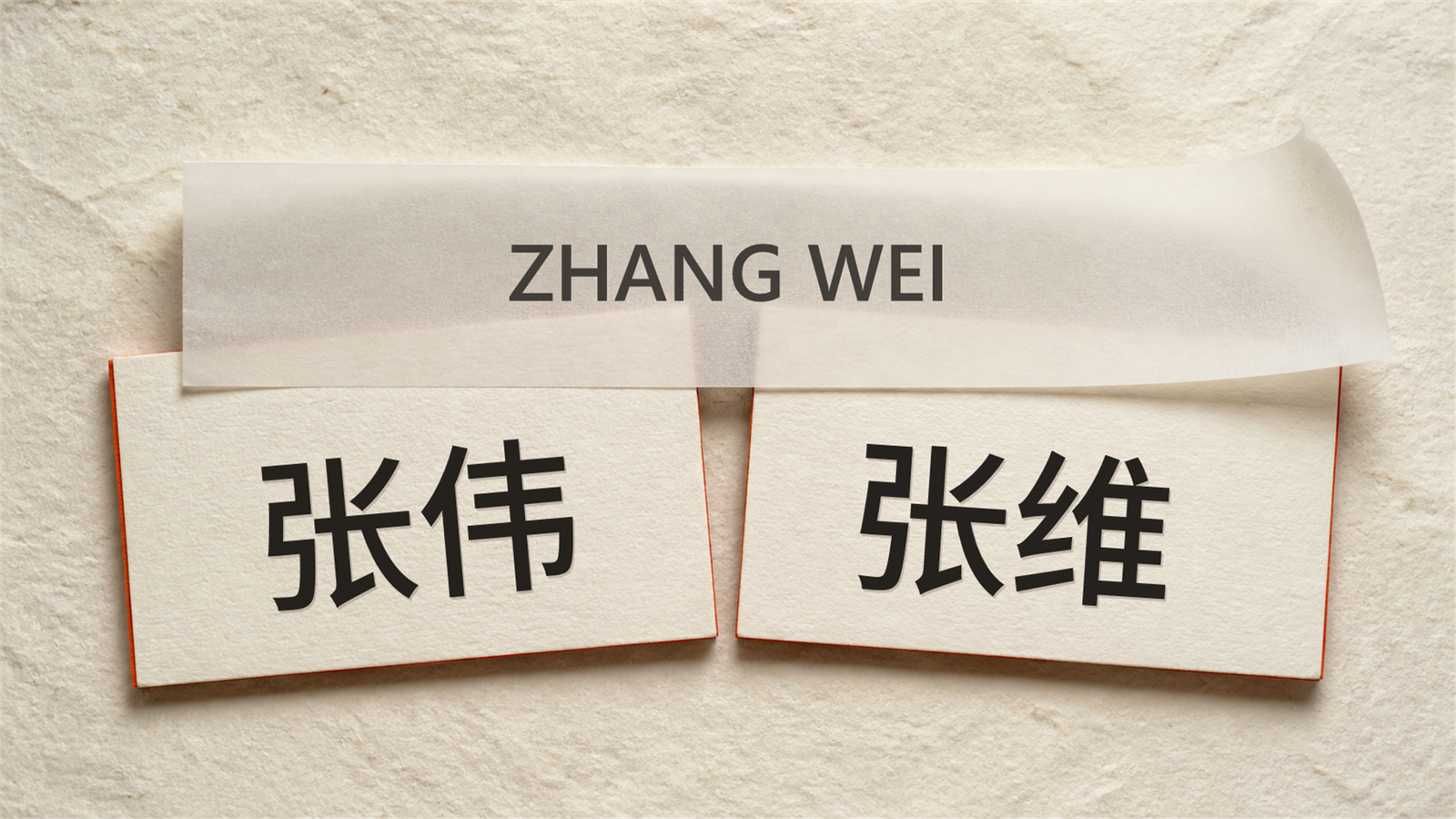
The Latin spelling Zhang Wei conceals information twice. Wei may represent different syllables when tone marks are omitted, and a single pronunciation may correspond to many characters. 张伟, 张维, 张威 and 张薇 can all be written Zhang Wei in ordinary unmarked spelling. They are not the same written name.
| Name | Standard Chinese reading | Selected character associations |
|---|---|---|
| 张伟 | Zhāng Wěi | 伟: great, imposing |
| 张维 | Zhāng Wéi | 维: hold together; dimension; linking fibre |
| 张威 | Zhāng Wēi | 威: authority; awe |
| 张薇 | Zhāng Wēi | 薇: a plant name used in personal names |
Table 1. Authorial explanatory table. Glosses indicate common lexical associations, not fixed translations of the people who bear these names.
No list of glosses can determine why a particular family chose a character. A name may have been selected for sound, graphic balance, a literary allusion, a generation rule, divination, family memory or several of these at once. Character meanings also change. Reading the name of the Shang founder 汤 as the modern common noun “hot water” would substitute a later lexical association for an ancient royal name.
A name is not a translated phrase
English profiles often convert Chinese personal names into miniature sentences. The practice can produce memorable prose, but it confuses lexical association with reference. A person named 伟 does not become “Great” in English any more than a person named Grace is translated into another language each time the name appears.
The characters remain relevant. They distinguish homophones and may reveal an intended allusion. The safest account gives the characters, pronunciation and contextual evidence, then describes possible associations without claiming that the name has one complete sentence-like meaning.
Surname history is more complicated than the character 姓
In contemporary use, 姓 xìng ordinarily means “surname”. Early Chinese sources also distinguish 姓 from 氏 shì, but the distinction varied by period, status and textual tradition. Later accounts often present 姓 as an inherited lineage category and 氏 as a branch or status designation. That summary can orient a reader, provided it is not projected unchanged across all early China.
The graph 姓 contains 女 “woman”, as do early prestige lineage names such as 姬 and 姜. In the theoretical reading advanced in the original essay, these forms preserve a graphic trace of archaic matrilineal organisation. The claim is interpretive and should be retained as such. A graph alone cannot date or reconstruct a whole social institution, so the argument still requires evidence from the earliest uses of 姓, individual lineage histories and dated kinship records.
Modern surnames are themselves historically layered. Some derive from ancient lineage designations, states, fiefs, offices, places or the names and titles of ancestors. Others entered Chinese records through migration, conquest, transliteration and administrative registration. The apparently compact list of common surnames therefore contains many different histories.
One person could have several names
The modern legal pattern of surname plus given name does not exhaust the historical repertoire. Different names and titles located a person within family, adulthood, literary life, office or posthumous memory.
| Term | Function | Qualification |
|---|---|---|
| 姓名 xìngmíng | surname and personal name | the ordinary modern legal identity |
| 名 míng | personal name | given by family; practices differed across periods |
| 字 zì | courtesy name | historically associated especially with adult, educated men, though usage was not uniform |
| 号 hào | assumed or style name | chosen or bestowed in literary, religious and social settings |
| 斋号 zhāihào | studio name | could identify a study and, by extension, its occupant |
| 谥号 shìhào | posthumous name | an evaluative title granted after death under particular political conventions |
| 庙号 miàohào | temple name | used for rulers in ancestral worship and historiography |
| 乳名 rǔmíng | childhood or familiar name | domestic practice, not a formal stage shared by everyone |
Table 2. Authorial explanatory synthesis. It maps historically attested categories without implying that every person possessed each one.
The Liji connects capping with entry into adulthood, and transmitted ritual traditions associate this transition with the use of a courtesy name. Actual practice varied by period, gender, class and community. A table of terms should therefore be read as a repertoire rather than a fixed life-cycle form.
Names also receded in intimate relationships. Siblings and relatives could be addressed through kinship and birth-order terms such as 大哥, “eldest elder brother”, 二姐, “second elder sister”, or 三妹, “third younger sister”. These expressions did more than avoid repetition. They located the speaker and addressee within a relational hierarchy. The original essay treats this replacement of the personal name by the relationship as another instance in which social position is carried by naming practice.
Rectifying names did not mean choosing personal names
The Confucian expression 正名 zhèngmíng is sometimes brought into discussions of naming because its usual English rendering is “rectification of names”. In Analects 13.3, however, the issue is the relation among titles, words, social roles and political order:
名不正,则言不顺;言不顺,则事不成。
If names are not correct, speech does not accord with things; if speech does not accord with things, affairs do not succeed.
Translation by the author.
The passage concerns correct designation and the consequences of disordered language. It is not a manual for selecting auspicious personal names. Its relevance lies elsewhere: naming classifies a person or office, and a classification can carry expectations about conduct.
Taboo changed written language
Personal names could affect texts far beyond the person who bore them. Under imperial name taboo, characters in the personal name of a ruler or revered ancestor might be avoided, altered or replaced. The practice changed over time and was never perfectly uniform.
One well-documented example concerns 唐高宗 Tang Gaozong, whose personal name was 李治 Li Zhi. During his reign, 治 could be replaced by 理 in transmitted and newly written texts. Such substitutions matter to textual criticism. A later form may reflect taboo avoidance rather than an author's original vocabulary.
Name taboo shows that a character in a personal name was not private in the modern sense. Political hierarchy could reorganise spelling, copying and lexical choice across an administrative and literary world.
Generation names make genealogy visible
Some lineages assign a shared character to members of the same generation. The shared element may be drawn from a poem or an ordered list. It turns the given name into a position within a genealogical sequence.
The descendants of Confucius provide a prominent example. A sequence authorised and extended under successive dynasties includes the line 令德维垂佑. In the conventional numbering of the Kong lineage, 令 marks the seventy-sixth generation and 德 the seventy-seventh. Kong Deyong 孔德墉, for example, was identified as a seventy-seventh-generation descendant. The earlier article's assignment of these characters to the fifty-sixth and fifty-seventh generations was incorrect.

Generation characters were never universal. Their use depended on lineage organisation and could be disrupted by migration, political campaigns, incomplete genealogies or personal choice. Even when two relatives share one written element, the place of that element within the given name may vary according to the lineage rule.
Mao Zedong 毛泽东 and his brothers Mao Zemin 毛泽民 and Mao Zetan 毛泽覃 share 泽 as a generation character. The example demonstrates that generation naming remained available within a family whose members later entered revolutionary politics. Their names should not be translated into prophetic sentences. The shared written element establishes the genealogical pattern; later biographies do not determine what the parents originally intended.
Cosmology as a naming practice
Naming manuals and specialists may evaluate the time of birth through 八字 bāzì, the “eight characters” assigned to year, month, day and hour in the calendrical stem-branch system. A name can then be selected in relation to 五行 wǔxíng, the Five Phases: wood, fire, earth, metal and water.
“Five elements” is a familiar translation, but it easily suggests five static substances. “Five Phases” better conveys a correlative system of processes and transformations. In naming, a character associated with water or wood may be chosen to supply a perceived lack or balance in a birth chart.
The practice is historically and socially real. That does not establish an empirical effect of characters on a person's future. Families may treat the reasoning as religious, customary, aesthetic, commercial or symbolic. The same procedure does not hold the same status for every participant.
The 214 Kangxi radicals should not be imported into this practice as if they were a complete set of semantic and phonetic building blocks. They are dictionary indexing headings. Naming specialists may attend to graphic components and stroke counts, but their systems are not descriptions of how the whole writing system works.
Literary memory inside a name
Classical texts supply phrases whose associations can be compressed into a personal name. The Classic of Poetry remains a major reservoir. The poem “Jing nü” includes the line:
静女其姝。
The composed young woman is beautiful.
Translation by the author.
静姝 Jìngshū can recall the line without functioning as a word-for-word translation of the bearer. The allusion is activated by readers who recognise the source. Other families may select the same characters for sound or general association without intending that poem. Literary resonance is available; motive requires evidence.
Component choice adds another layer. 木 in 梅 links the graph to a botanical field, while 艹 in 花 does the same. A name such as 梅花 can evoke the plum blossom's large poetic tradition. The character components organise meaning, but the Kangxi radical list is not the generative inventory of the script and cannot by itself explain the name.
Gender, region and class
Naming frequencies show gendered tendencies without creating a grammatical gender system. Characters associated with strength, public achievement or martial qualities have been more frequent in male names in some periods; beauty, flowers, jade and lunar imagery have been more frequent in female names. Many characters remain usable across genders, and current practice changes with cohort, region and family preference.
The original essay further proposed distinct northern, southern and coastal naming profiles, and linked naming complexity to social class. Those are empirical propositions, not self-validating cultural categories. They require a defined corpus that controls for period, migration, urbanisation and population size. The present web edition preserves the research question but does not repeat regional examples as established national patterns without that evidence.
Class difference is more securely visible in access to literary education, genealogies and multiple formal names. It does not follow that people without elite schooling possessed only crude or purely practical identities. Oral traditions, childhood names, occupational references and local naming rules could be elaborate even when they left fewer written sources.
Zhu Yuanzhang's early name 朱重八 and his father's name 朱五四 are frequently cited examples of number-based naming in a poor Yuan-period family. The names are documented; their exact logic is debated. They should not be presented as proof that poor families lacked “proper” names or could not afford naming consultants. Zhu's later adoption of 朱元璋 shows how a change of status could bring a new formal name, but it does not reveal one universal peasant naming system.
Names record their moment
Personal names can preserve collective events and changing aspirations. Names such as 建国 “establish the country”, 国庆 “national celebration” and 建军 “build the army” are strongly associated with the political vocabulary of the People's Republic. Later cohorts show other clusters of preferred characters and two-character combinations.
Administrative name reports provide evidence for these shifts, but they must be read as datasets with boundaries. The Ministry of Public Security's national reports cover the registered population of mainland China and distinguish total population from newly registered births. They do not justify a single story about why every parent chose a name. Frequency can show a cohort pattern; motive requires other evidence.
The May Fourth Movement is dated to 1919, within the longer New Culture movement of the mid-1910s and early 1920s. It encouraged new arguments about language, family and the individual, but there was no instant replacement of “traditional names” with “modern names”. Revolutionary, literary, religious and lineage practices overlapped throughout the twentieth century.
The founding of the People's Republic in 1949 made 建国, 解放 and 胜利 available as intimate records of a national event. During the Cultural Revolution, 红, 卫, 东 and military vocabulary became conspicuous in names. Such choices could express conviction, hope, conformity, protection or several motives at once. The characters date a cultural field more securely than they reveal an individual family's private reasoning.
The original essay proposed that the one-child policy weakened generation naming because fewer siblings needed coordinated names. That causal proposition is plausible but not demonstrated by the present sources. A proper test would distinguish siblings from cousins within a lineage, compare periods and regions, and separate policy effects from urbanisation, migration and changes in genealogy. It remains a question for the author rather than a statement of fact in this edition.
Recent naming combines individualisation with inherited resources. Parents may search for uncommon combinations, revive rare graphs, consult literary databases or retain generation characters. Unusual celebrity names show what is possible but should not be translated into invented English sentences or treated as representative population data.
Spoken names, written distinctions
Chinese speakers routinely repair the loss of information in speech. A name can be specified through a familiar word, a component, a historical person or a written example: 魏 from the ancient state, 维 as in 维护, or 薇 with the plant component. A business card or messaging profile supplies the graph that spoken form lacks and thereby resolves the homophony.
The same surname pronunciation can represent distinct surnames, but the graph does not automatically prove one family origin or occupation. 魏 may be historically connected with the state name; 韦 also has the lexical meaning “leather”. A modern bearer requires genealogical evidence before either association becomes an ancestry claim.
International spelling adds another reduction. Tone marks are usually omitted, and older or community-specific romanisations may follow different standards or Chinese varieties. The same person can consequently appear under several Latin spellings in archives. Overseas families may use a Chinese name, a local-language name and a family romanisation in different settings. This is not evidence that one identity is false. It is evidence that names operate across several documentary systems.
Naming expertise in a digital market
Professional name selection continues in consultancy, publishing, websites and applications. Services may combine birth-time calculation, Five Phase balancing, stroke-count systems, sound, character structure and contemporary concerns such as international pronunciation or trademark search.
The continuity is real at the level of practice: older calculative and literary resources are offered through modern software and commerce. Claims made by particular services, including purported effects on fortune or unverified user numbers, require separate evaluation. No application is cited here as proof that one method represents Chinese naming as a whole.
When a legal name exceeds the computer
Rare characters make the distinction between writing and data infrastructure tangible. A name may be valid in family records and dictionaries yet fail in a bank, hospital, ticketing service or local database because the software cannot encode, display or exchange the character correctly.
China's current mandatory national standard GB 18030-2022 was released in 2022 and entered into effect on 1 August 2023. It includes 87,887 Chinese characters, more than 17,000 of them additions described by the issuing authorities as rare characters. The expansion was explicitly intended to improve support for uncommon characters in personal and place names as well as historical and specialist texts.
Encoding does not solve every problem. Fonts must contain usable glyphs; input methods must make the character findable; databases must preserve the code point; identity systems must exchange it without substitution. A person can therefore encounter several technical failures after the character itself has been standardised.
The problem reverses a common assumption. The rare name is not necessarily defective. The information system may have been built around an inventory too small for the names it is meant to administer.
What the written name preserves
A Chinese personal name is not a transparent description of its bearer. It is a conventional identifier situated within a writing system and a social history. Its characters may distinguish homophones, connect generations, recall a text or event, satisfy a naming practice or simply produce a sound and form that a family preferred.
Romanisation is necessary for many international purposes. It becomes misleading only when it is treated as the complete name rather than one representation of it. Zhang Wei is usable. 张伟, 张维, 张威 and 张薇 explain why it is not enough.
References
- 中国新闻网 / 新民晚报. “‘张伟’人数庞大 多达29万人.” 26 July 2007. The report attributes the figure of 290,607 to the national citizen identity-information system.
- 公安部户政管理研究中心. “《二〇二一年全国姓名报告》发布.” 24 January 2022.
- Bauer, Wolfgang. “Personal Names in Chinese.” Names 5, no. 3 (1957): 163–178. PDF.
- Agnew, Christopher S. The Kongs of Qufu: Descendants of Confucius in Late Imperial China. University of Washington Press, 2019.
- Lunyu, “Zi Lu” 13.3. Chinese Text Project. Accessed 18 August 2026.
- Liji, “Qu Li I” and “Guan Yi.” Chinese Text Project. Accessed 18 August 2026.
- Kinoshita, Tetsuya. “From ‘Zhi 治’ to ‘Li 理’: A Change in the Key Term of Political Thinking in the Tang-Song Period.” Tōyōshi Kenkyū 55, no. 3 (1996): 467–501.
- China Daily. “Family tree of Confucius revised.” 15 November 2012.
- Major, John S., Sarah A. Queen, Andrew Seth Meyer and Harold D. Roth, trans. and eds. The Huainanzi: A Guide to the Theory and Practice of Government in Early Han China. Columbia University Press, 2010.
- Mitter, Rana. A Bitter Revolution: China's Struggle with the Modern World. Oxford University Press, 2004.
- Standardization Administration of China. “GB 18030-2022: Information technology, Chinese coded character set.” Released 19 July 2022; implemented 1 August 2023.
- Standardization Administration of China. “National Standard on Information Technology Released.” 28 July 2022.
- Shijing, “Jing nü.” Chinese Text Project. Accessed 18 August 2026.
- Mote, Frederick W. Imperial China, 900–1800. Harvard University Press, 1999. Cited for Zhu Yuanzhang's family and historical setting.
- Kulmala, Toni. “What's in a Name?” Original Mandariini essay, 19 June 2025. Cited as the source of the article's interpretive framework and research propositions.